
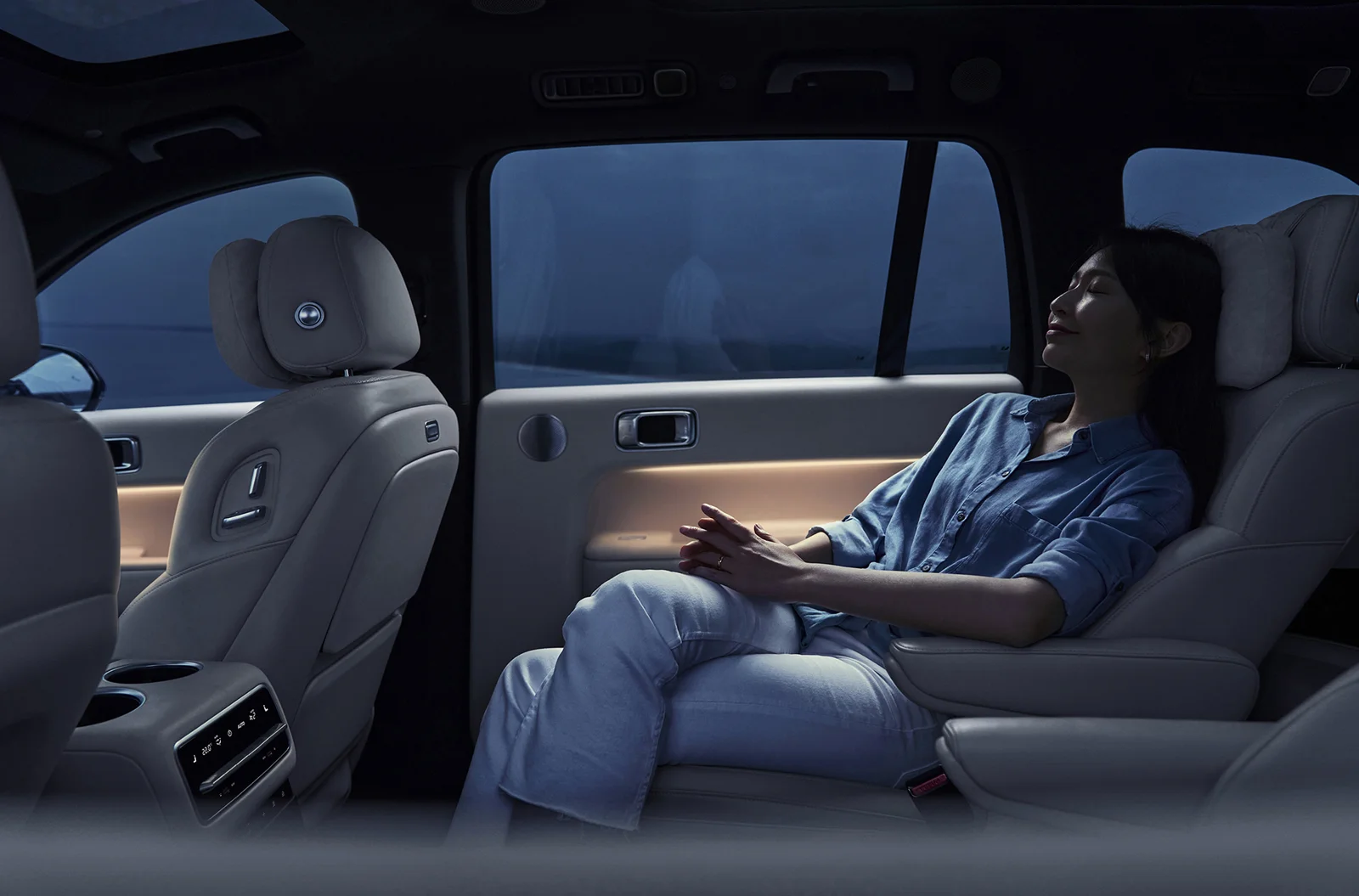
Plan the passenger arrangement
The June 2022 launch specification describes six seats and a 3,105 mm wheelbase. These are useful historical identifiers, not luggage-fit measurements or a specification for every later L9. Check the quoted vehicle before arranging transport or promising passenger accommodation.
Record usual occupancy and any entry or exit needs. A second-row comfort demonstration does not answer every question about access to the back of the cabin. Ask for a review of the intended seating arrangement, including the adjustments that passengers will use in ordinary travel.
Where child restraints are involved, assess the intended combination against the vehicle and restraint instructions. Do not claim universal suitability from a lifestyle picture. The reference photographs show a historical model presentation rather than a fitting test for an individual family.
When child restraints are required, the L9 child-seat and ISOFIX review checks the exact restraint, approved position and family access. A historical anchor count is not a universal fit approval.
The L8 passenger-led comparison assesses one occupied family journey before a higher-positioned badge earns a premium.
The ROX family/outdoor comparison balances the recurring passenger task against specifically identified outdoor needs and accepted concessions.
The D9 passenger-access comparison compares the passenger’s movement and occupied baggage task rather than declaring an entire vehicle category universally suitable.
For regular adult use, the adult third-row journey review fixes normal settings ahead and states the limits of remote personal assessment.
The older-passenger access decision separates entry, established position and exit for the actual person instead of inferring needs from age.
For two regular drivers, the shared-driver position review reviews each normal front position and the space left on the relevant journey.
The company airport assignment review describes the assigned driver, clients and bags instead of treating business presentation as a universal use result.
Check luggage with the seats in use
Describe the cases, pushchair or work items by the dimensions that matter. Request opening and usable-space measurements with the necessary seats available for passengers. Folded-seat capacity and luggage accommodation with all required occupants are different questions.
A demonstration should identify seat positions and the items being loaded. If remote evidence cannot establish fit, leave the requirement unconfirmed. A large quoted volume should not become a promise that every awkward item passes through the opening or fits the intended arrangement.
For journeys using all required seats, the L9 six-seat luggage review checks the remaining load area and practical access rather than folded-seat capacity alone.
Verify the comfort functions individually
List the seat, climate and convenience functions the customer requires. Equipment and operating arrangements may differ by period and configuration. Use the version record rather than treating a launch-period image as a universal feature list.
For used cars, record wear, adjustment operation and any damaged controls within the agreed inspection scope. A clean cabin does not prove complete maintenance history or the condition of every function. The new and used guide keeps those expectations separate.
For comfort and entertainment requirements, the L9 refrigerator and rear-screen checklist separates fitted equipment, demonstrated operation and online dependencies.
The second-row premium decision keeps the other required occupants in position before a second-row adjustment is valued.
The glass-roof and shade decision values the passenger’s intended routine while keeping climate observations within their represented conditions.
Include everyday parking and loading needs
Ask about normal parking spaces, loading access and the customer’s practical use. Confirm dimensions for the actual offered version when they matter, rather than borrowing a number from another production period. Include locally relevant support requirements in the purchasing brief.
If cabin screens or remote features influence the decision, review their destination operation under the software guide. A visible screen is not proof of all online services. Keep the final description limited to the configuration and demonstrations actually accepted.
For a restricted parking space, the L9 garage-fit checklist adds mirror width, entrance route, door access and tailgate clearance to the vehicle comparison.
A practical comparison
A family expects to use the rear row regularly while carrying several cases. The seller supplies an image with seats folded and no luggage. Request evidence with the intended occupancy instead. If case dimensions are available, ask for measurements or a relevant loading demonstration. Record which part of the requirement was tested and what remains uncertain. This gives the dealer a precise basis for discussing suitability instead of presenting a maximum-capacity image as an answer to a different use case.
Manufacturer context: 2022 L9 introduction, 2024 L-series update, and May 2026 L9 announcement (PDF). The actual offer requires its own specification and condition evidence.